Mobile-Phone
+86 13003754630

NingBo FengSound Electronic Co.,Ltd.
Spec sheets mix four different measurement systems, and almost nobody explains which is which. FengSound (NingBo FengSound Electronic Co., Ltd.), a Pro audio manufacturer in Ningbo, China that supplies OEM line array systems to distributors in 70+ countries, publishes both peak and RMS figures on every model for exactly this reason. Here is how to read portable line array power rating rms vs peak explained for buyers without a physics degree — and which three lines on the sheet predict real output.
RMS is the power a system can sustain for hours without damage; peak is a millisecond burst that no real program material ever reproduces. Any portable line array power rating rms vs peak explained for buyers comes down to that one distinction, yet manufacturers test to different standards — the same cabinet can appear as 800W, 1,600W, or 3,200W depending on which line you read.
| Spec on the Sheet | What It Really Means | How a Buyer Should Use It |
| RMS / continuous (AES) | Sustained thermal limit, tested with pink noise | The number to compare across brands |
| Program / music power | Typically 1.5-2× RMS, assumes real music crest factor | Ignore for comparing brands |
| Peak | 2-4× RMS, millisecond transient | Marketing only — never the basis of a decision |
| Max SPL (dB) | Loudest clean output at 1 m | The single most useful output spec |
| Sensitivity (dB/W/1m) | Efficiency: output per watt | Explains why low-power systems can play loud |
Three practical consequences:
✅ Bottom line: Compare RMS and max SPL, treat peak as decoration, and leave 20% headroom so the system never runs at its thermal ceiling.
Sensitivity and maximum SPL predict loudness; frequency response and dispersion predict coverage; subwoofer pairing predicts whether music sounds finished. Wattage only matters once you know these three numbers.
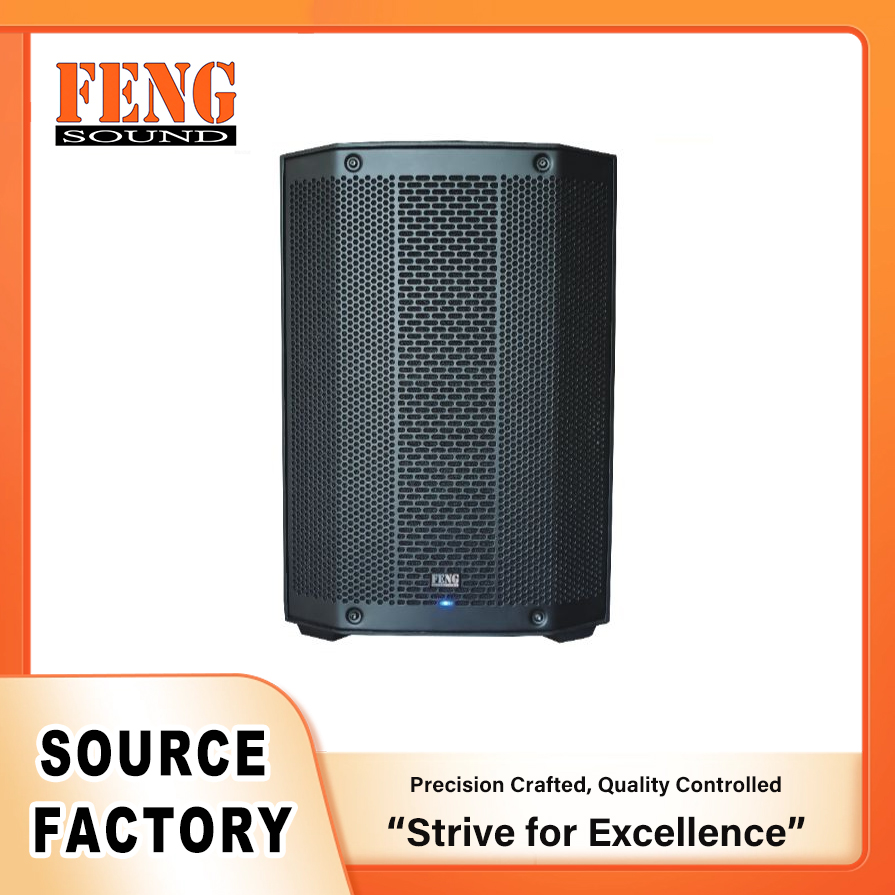
Knowing how to calculate spl requirements for outdoor stage speakers means starting from the target level at the farthest listener and working backwards. Every doubling of distance costs about 6dB in open air (roughly 3dB for a coupled line array until it decouples), and every doubling of power adds only 3dB.
A worked example: a column rated 97dB sensitivity and 125dB max SPL, driven with 400W, produces about 123dB at 1 m. At 25 m outdoors that is roughly 95-99dB at the back row — enough for speech and light music, short of a loud DJ set. That gap is why outdoor stages need either more boxes or higher-sensitivity cabinets, not simply a bigger amplifier.
Any subwoofer pairing guide for portable column array systems starts with the crossover and the power split: aim for 1.5-2× the top's continuous power in the sub, set the crossover at 100-120Hz for columns, and confirm the DSP preset matches the sub you actually bought. Two details decide whether it works in practice:

✅ Bottom line: Sensitivity plus max SPL tells you how loud it goes, dispersion tells you where it lands, and a correctly matched sub tells you whether it sounds complete.
Q: Is portable line array power rating rms vs peak explained for buyers anywhere on the box?
A: Rarely in plain language. If a listing shows only one wattage figure, ask the supplier for the AES or continuous rating and the max SPL — reputable manufacturers such as FengSound quote both, and a refusal to answer is your answer.
Q: How do I calculate SPL requirements for outdoor stage speakers?
A: Start with the target at the last row (about 105dB for speech, 115-120dB peaks for live music), then add 6dB per doubling of distance and 10-15dB for wind and crowd noise. Compare that figure to the system's max SPL, not its wattage.
Q: What sensitivity should a portable line array have?
A: 95-100dB (1W/1m) is typical and healthy for compact columns. Below 92dB you are buying amplifier power to compensate for inefficient drivers, which shortens battery runtime and raises heat.
FengSound publishes RMS, peak, sensitivity, max SPL, and dispersion for every model, and our engineers will map a configuration against your venue sizes before you commit. As an OEM/ODM factory, NingBo FengSound Electronic Co., Ltd. also supplies custom DSP presets, driver configurations, and private-label branding for wholesale programs, with samples available from a single set. Ask for the complete spec pack and a factory-direct quote today.
|
|
|
| *Published: October 2026 | By FengSound Engineering Team* |


Let's get in touch.
NingBo FengSound Electronic Co.,Ltdestablished in August 2010,is a comprehensive stationary enterprise integrateddesign, manufacturing and sales as an organic whole.We seek to produce highquality... Subscribe Our Newsletter
Related Products List

Privacy statement: Your privacy is very important to Us. Our company promises not to disclose your personal information to any external company with out your explicit permission.
Fill in more information so that we can get in touch with you faster
Privacy statement: Your privacy is very important to Us. Our company promises not to disclose your personal information to any external company with out your explicit permission.